Directions: Click the "Begin" button below to access an interactive drag and drop version of this graphics, which will help reinforce the concepts you have been studying.

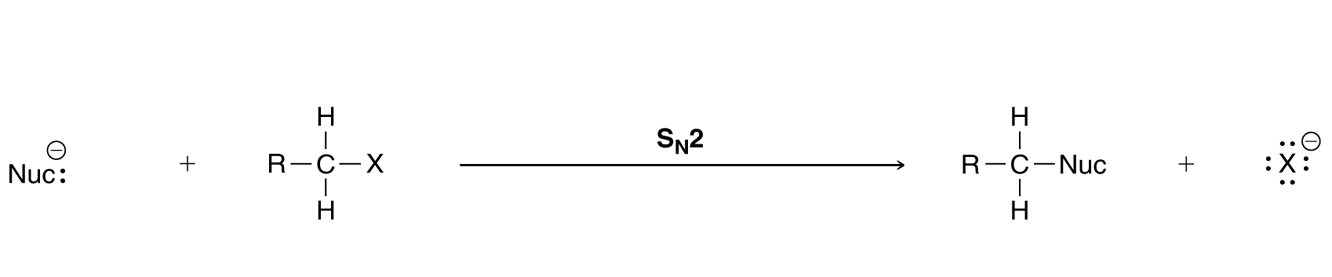
An S N 2 reaction depicts the formation of two products using a nucleophile and an alkyl halide. Nucleophile, N u c, attacks the reactant, alkyl halide that has a central carbon atom single bonded to two hydrogen atoms, an alkyl group, R, and a halogen atom, X. The nucleophile has a lone pair of electrons and a negative charge. A curved arrow from the lone pair of electrons points toward the carbon atom. Another curved arrow from the single bond between carbon atom and halogen atom, X, points on the outer side of the same halogen atom. Text above the curved arrow reads: Loss of leaving group. Text below the rightward arrow reads: A nucleophile attacks the alkyl halide, causing the loss of a leaving group in a concerted fashion (simultaneous). The structure of product is similar to the reactant, except that the halogen atom, X, is replaced by a nucleophile. The second product, a halide ion, X with four lone pairs of electrons and a negative charge, departs the reaction. The curved arrows in the reaction are highlighted.
Begin

Directions: Click the "Next" button below to access an interactive drag and drop version of this graphic, which will help reinforce the concepts you have been studying.

An S N 2 reaction depicts the formation of two products using a nucleophile and an alkyl halide. Nucleophile, N u c, attacks the reactant, alkyl halide that has a central carbon atom single bonded to two hydrogen atoms, an alkyl group, R, and a halogen atom, X. The nucleophile has a lone pair of electrons and a negative charge. A curved arrow from the lone pair of electrons points toward the carbon atom. Another curved arrow from the single bond between carbon atom and halogen atom, X, points on the outer side of the same halogen atom. Text above the curved arrow reads: Loss of leaving group. Text below the rightward arrow reads: A nucleophile attacks the alkyl halide, causing the loss of a leaving group in a concerted fashion (simultaneous). The structure of product is similar to the reactant, except that the halogen atom, X, is replaced by a nucleophile. The second product, a halide ion, X with four lone pairs of electrons and a negative charge, departs the reaction. The curved arrows in the reaction are highlighted.
Next

graphic
A nucleophile attacks the alkyl halide, causing the loss of a leaving group in a concerted fashion (simultaneous)
Hide Graphic
Reset
View Graphic
Begin

Close